
Mansion House Paintings
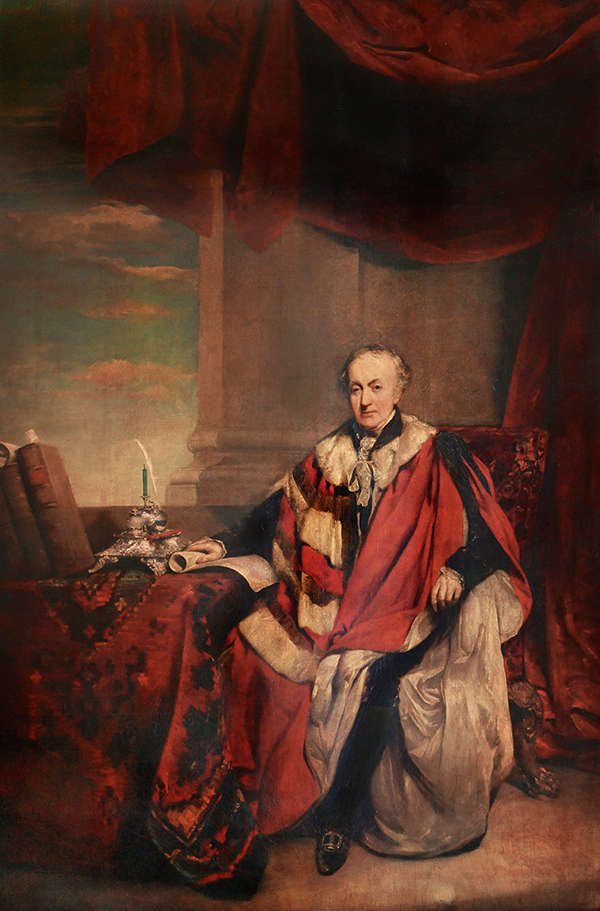
The Portrait of the Fourth Earl Fitzwilliam
An article by Brian Barber, the former Archivist of Doncaster Council and author of A History of Doncaster.
Subject The fourth Earl Fitzwilliam lived from 1748 to 1833. Like his uncle, the Marquess of Rockingham, he was a racehorse owner, and his horses won the St Leger twice, in 1802 and again 1807. His political talents were not of the same calibre as the marquess, but the close relationship between landed wealth and political power placed him briefly in positions of prominence. He served as Lord Lieutenant of Ireland in 1794-5 and as Lord President of the Privy Council in the short-lived Whig ministry of 1806-7. He was also appointed as lord lieutenant of the West Riding, but was dismissed from office in 1819. He had taken part in an anti-government protest at a county meeting in York against the ‘Peterloo’ massacre in Manchester. The meeting was chaired by a fellow supporter of moderate reform, William Wrightson of Cusworth Hall, who had convened the meeting, as was his right as sheriff of Yorkshire. The earl is now principally remembered as the patron of Edmund Burke, the eighteenth-century politician and political writer, whose papers, principally his voluminous correspondence, he assiduously collected after Burke’s death. These papers are now to be found with all the records from Wentworth Woodhouse at Sheffield Archives.
The fourth Earl Fitzwilliam was the nephew of the childless Marquess of Rockingham and became his heir. The Fitzwilliam family had extensive estates in both England and Ireland. They had been made earls in the peerage of Ireland in 1716 then, thirty years later, in 1746, the third earl Fitzwilliam was given a British earldom as well, making him the third earl Fitzwilliam in Ireland but the first earl Fitzwilliam in Great Britain. So the fourth earl was, in Britain, properly the second earl. However, the earls Fitzwilliam always numbered themselves by their Irish, rather than their British title. They continued to do so even after their Irish peerage became a merely nominal title after the creation of the Irish Free State, as it then was, in 1922. At that date, all Irish peers were created barons in the peerage of the United Kingdom but allowed to keep their Irish rank as honorary titles.
Painter John Jackson was born in 1778, the son of a tailor of Lastingham in North Yorkshire. His talents had attracted the notice of a local peer, the Earl of Mulgrave, the owner of Mulgrave Castle near Whitby. (This is an eighteenth-century country house, but the nearby ruined castle was, coincidentally, the home of the medieval lords of the manor of Doncaster.) The young Jackson was taken into the patronage of Sir George Beaumont and the Earl of Carlisle and attended the Royal Academy schools. By 1826, when he was chosen to portray Earl Fitzwilliam he had a national reputation as a skilled and prolific portrait painter, and had become a Royal Academician in 1817. He died in 1831.
History of the Portrait The spur to the painting of his portrait came in December 1823, through an apparently unsolicited offer from someone named In the records of Doncaster corporation as ‘Mr Marshall’ to present the corporation with a portrait of the earl. This was almost certainly Benjamin Marshall (1768-1835), who had begun his career as a portrait painter but had later come to specialise in painting animals, especially race horses. The corporation approached Lord Milton, the earl’s eldest son, for advice about how best to proceed. In June 1824, Lord Milton replied that the family’s preference would not be for Marshall, but for one of the two leading portrait artists of the day, Sir Thomas Lawrence or John Jackson. Sir Thomas was the leading portrait painter of his day, the president of he Royal Academy, with commissions that included George IV and Pope Pius VII, and with fees to match. So the earl sensibly chose Jackson and paid for the portrait himself.
The picture had arrived in Doncaster by the end of September 1826, and a deputation visited Wentworth Woodhouse with a formal address of thanks. The address ended by expressing the hope that the portrait would, ‘be the means of maintaining to the House of Wentworth and the corporation of Doncaster a kind and honourable regard for, and connection with, each other long after the present generation will have passed away and your Lordship has been called to receive the reward of all your virtues’. Such a sentiment must have been greatly consoling to the earl who was then seventy-eight.
A few years later, in 1827, Lord Milton arranged for Lawrence to paint a portrait of his father. He paid Lawrence half his fee, 300 of the total of 600 guineas, when the commission was agreed. (300 guineas was more than the annual income of a comfortably-off middle class family at that time.) Lawrence was notoriously dilatory in finishing his commissions, and when he died three years later the picture was still not complete. However, the head itself was finished, and regarded as a good likeness. Lord Milton agreed to pay a further £157 to John Simpson (1772-1847), one of Lawrence‘s studio assistants, and an able portraitist in his own right, to compete the work. This remains in the possession of the family.
Location of the Portrait Mansion House Ballroom