THE DONCASTER MANSION HOUSE PORTRAITS 1: THE BALLROOM
The portrait information was prepared by Brian Barber, the former Archivist of Doncaster Council and author of A History of Doncaster.
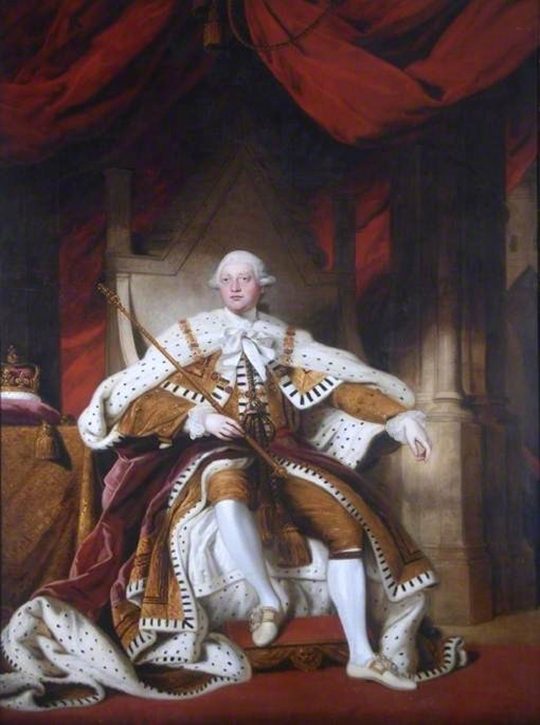
King George III
Subject George III, King of Great Britain and Ireland from 1760 to 1820 in his coronation robes. He was born in 1738. He succeeded his grandfather, George II, as king since his father, Frederick, Prince of Wales had died in 1751.
Painter this is a copy by Samuel Woodford of a portrait by Sir Joshua Reynolds. Reynolds’ portrait was painted for the Royal Academy’s first summer exhibition at Somerset House, London in 1780, so two decades after the date of the coronation. In 1780 Reynolds was knighted and appointed the Academy’s first president by George III. The king had never commissioned any painting from Reynolds himself, and regarded the Scottish artist Allan Ramsay as his painter. Ramsay had painted a splendid coronation portrait of the king, and Reynolds was not prepared to be out-done, so produced a portrait twenty years after the event it was supposed to commemorate.
Reynolds’ painting, and his accompanying portrait of Queen Charlotte, remain in the possession of the Royal Academy, where they were copied a number of times. One copy, by an unidentified artist, is to be found in the Royal Collection. Another, by the Yorkshire-born artist John Jackson, is to be found at Chester Town Hall. The Doncaster version was painted by Samuel Woodford (1763-1817), a talented and prolific artist, trained at the Royal Academy schools. He exhibited regularly in London and became a Royal Academician in 1807.
History of the Portrait This portrait was a gift from Sampson Gideon, the son of a London banker, who was created Lord Eardley in 1789. He had no son, so his title died with him. His three daughters were his joint heiresses and the youngest of them, Sarah, married John Walbanke Childers of Cantley Hall in March 1792. The Childers family had originated as Doncaster merchants. In the later sixteenth century the family achieved the typical ambition of rich businessmen of the period bought a country estate at nearby Cantley and retained it until the twentieth century.
J. W. Childers probably hosted his father-in-law’s visits to Doncaster during the racing season. In December 1803, the corporation decided to make Lord Eardley a freeman of the borough. The peer responded to the corporation’s polite gesture a year later, in September 1804, when his son in law was joint steward of the races. He gave the corporation this full-length portrait of an enthroned George III in coronation robes. At its next meeting, the corporation expressed its thanks by making him a councillor.
Eardley had been an MP for Coventry from 1784 to 1796 and had presented that borough with a portrait of the king by Thomas Lawrence, the future president of the Royal Academy who became the leading portrait painter of his day. With no more than a social connection to Doncaster, Lord Eardley probably thought that a more modest commission was sufficient for the town. However, his choice of the Reynolds portrait as its model was a popular contemporary choice. Seven versions of it are to be found elsewhere, including the guildhall at Bath, in Plymouth, Sudbury Hall in south Derbyshire, Belton House in Lincolnshire and Attingham Park in Shropshire.
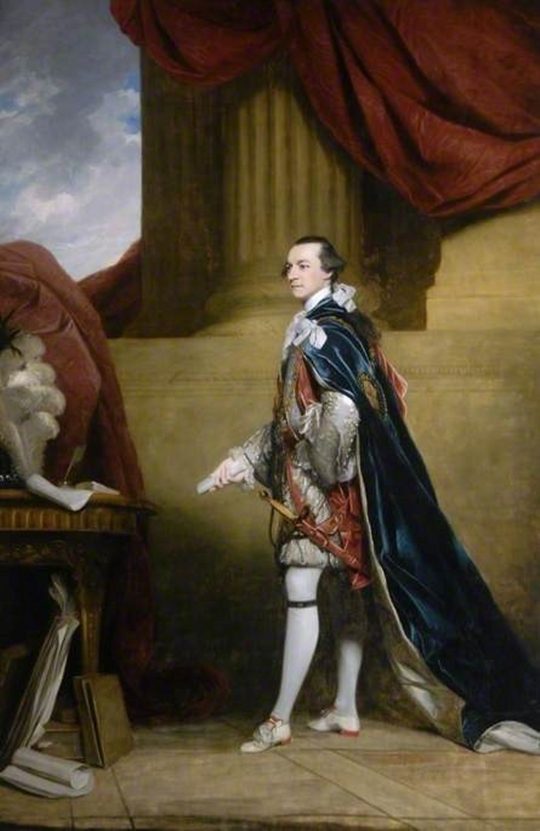
Marquess of Rockingham
Subject The second Marquess of Rockingham was a local grandee. Born in 1730, the marquess had succeeded to his extensive estates in Yorkshire and Northamptonshire in 1751, at the age of only 21. Although often resident at Wentworth Woodhouse, the improbably large mansion built by his father a few miles from Rotherham, the marquess had no long-standing association with Yorkshire. The title adopted by the first marquess derives from his castle at Rockingham in Northamptonshire. It was only through the failure of heirs that the Yorkshire estates of the Earl of Strafford came into the possession of his nephew, the first marquess.
The second marquess was not merely an important figure in Yorkshire but in national life. He became a leading figure in the parliamentary ‘Whig’ party. There were the members of the aristocracy and their followers who favoured moderate political reform and a merely constitutional monarchy. He himself was in favour of what was called ‘economical reform’. This was a scheme to reduce the influence of the Crown by reducing the number of paid posts it could use to reward its supporters and which influenced votes in parliamentary. Because of the hostility of George III, Rockingham became Prime Minister twice but only briefly: once for a year in 1765-66 and again in 1782. His second term of office was ended abruptly by his death, only three months afterwards, at the age of 52.
He was also closely involved with the highlight of Doncaster’s social season as a patron of the race course. In 1776 he was one of a committee of four to whom the corporation committed the commissioning of both a new course and a new grandstand. In the same year his horse, won a newly established race for two-year old horses. At the suggestion of the marquess, this race was named after Colonel St Leger. The Doncaster ‘St Leger’ is the oldest of the ‘classics’ of the racing calendar.
Painter Like George III, this portrait is another copy of a work by Sir Joshua Reynolds. Reynolds had painted the original sometime between 1766 and 1768. It had cost the marquess £157.18s, although Reynolds did not receive his fee until sometime after July 1781.
The copy here was painted by Thomas Phillips (1770-1845), a London-based portrait painter, who was already well-known and then on the threshold of considerable success. Shortly afterwards he became a Royal Academician. His most famous portrait is of the poet Lord Byron in Albanian dress.
History of the Portrait The corporation of Doncaster naturally chose to foster links with the most powerful nobleman in the district. On his inheritance they hastened to make the second marquess an honorary freeman of the borough. It presented him with the certificate of freedom in a silver gilt box. Both certificate and box are now to be found at Sheffield Archives with the other archives of the family.
In October 1804, the corporation agreed to a proposal of the mansion house committee that there should be a portrait of the marquess on the walls of the Mansion House. The committee chose not to commission its own portrait but to obtain a copy of this existing work by Reynolds, one of the most celebrated artists of the day.
By 1804, Wentworth Woodhouse and all the marquess of Rockingham’s estates had been inherited by his heir, the Earl Fitzwilliam. The committee applied to the earl to have a copy made of the portrait. The Earl apparently decided to have a copy made at his own expense for, in September 1805, the corporation minutes record its thanks to Earl Fitzwilliam for having presented the picture to the corporation. Lord Fitzwilliam, in choosing a highly talented artist to make the copy, was treating the corporation with generosity.
The decision of the corporation to obtain the portrait was probably influenced by preparations for the attendance of George, Prince of Wales (the eldest son of King George III) at Doncaster races in 1806. Substantial preparations were underway to add a new dining room to the mansion house, to designs by local architect William Lindley. This was explicitly being undertaken in time for the royal visit of both the Prince of Wales and his brother, Prince William, Duke of Clarence. The two brothers were to be head of state, as Prince Regent and then George IV, followed by William IV, for over quarter of a century from 1810 to 1837.
The Prince of Wales was a known to be an admirer of Reynolds. Indeed, he had himself actually commissioned a copy of this same portrait of the marquess of Rockingham two decades earlier. The portrait is still to be found in the Royal Collection. So perhaps the corporation thought that adorning the Mansion House, which the Prince would, of course, visit, with two pictures copied from a painter the Prince was known to admire was a sophisticated and complimentary gestures. That these gestures could be made entirely at the expense of others was no doubt welcomed by the corporation as unforeseen bonus.
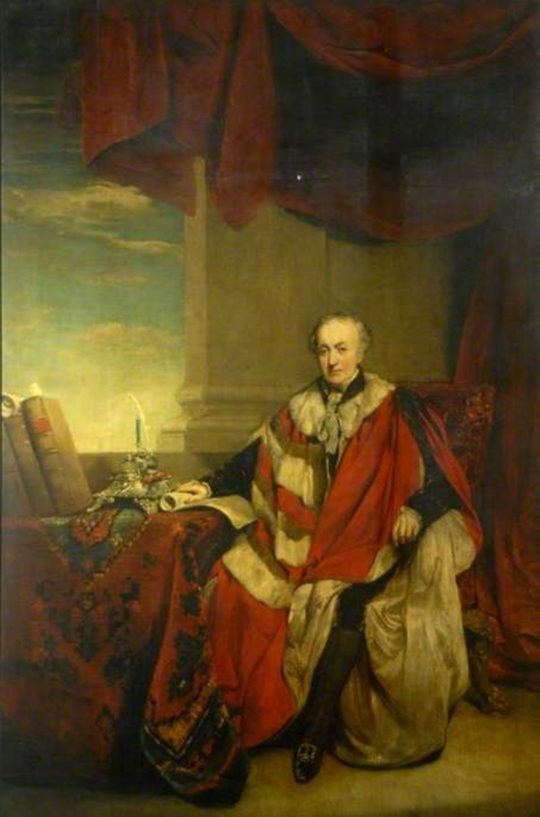
Fourth Earl Fitzwilliam
Subject The fourth Earl Fitzwilliam was the nephew of the childless Marquess of Rockingham and became his heir. The Fitzwilliams had extensive estates in Ireland as well as England. They had been made earls in the peerage of Ireland in 1716 then, thirty years later, in 1746, the third earl Fitzwilliam was given a British earldom as well, making him the third earl Fitzwilliam in Ireland but the first earl Fitzwilliam in Great Britain. So the fourth earl was, in Britain, properly the second earl. However, the earls Fitzwilliam always numbered themselves by their Irish, rather than their British title. They continued to do so even after their Irish peerage became a merely nominal title after the creation of the Republic of Ireland in 1922.
The fourth Earl Fitzwilliam lived from 1748 to 1833. Like his uncle, the Marquess of Rockingham, he was a racehorse owner, and his horses won the St Leger twice, in 1802 and again 1807. His political talents were not of the same calibre as the marquess, but the close relationship between landed wealth and political power placed him briefly in positions of prominence. He served as Lord Lieutenant of Ireland in 1794-5 and as Lord President of the Privy Council in the short-lived Whig ministry of 1806-7. He was also appointed as lord lieutenant of the West Riding, but was dismissed from office in 1819. He had taken part in an anti-government protest at a county meeting in York against the ‘Peterloo’ massacre in Manchester. The meeting was chaired by a fellow supporter of moderate reform, William Wrightson of Cusworth Hall, who had convened the meeting, as was his right as sheriff of Yorkshire. The earl is now principally remembered as the patron of Edmund Burke, the eighteenth-century politician and political writer, whose papers, principally his voluminous correspondence, he assiduously collected after Burke’s death. These papers are now to be found with all the records from Wentworth Woodhouse at Sheffield Archives.
Painter John Jackson was born in 1778, the son of a tailor of Lastingham in North Yorkshire. His talents had attracted the notice of a local peer, the Earl of Mulgrave, the owner of Mulgrave Castle near Whitby. This is an eighteenth-century country house, but the nearby ruined castle, coincidentally, was the home of the medieval lords of the manor of Doncaster. The young Jackson was taken into the patronage of Sir George Beaumont and the Earl of Carlisle and attended the Royal Academy schools. By 1826, when he was chosen to portray Earl Fitzwilliam he had a national reputation as a skilled and prolific painter, and had become a Royal Academician in 1817. He died in 1831. So the portrait here is of a notable Yorkshire peer by a notable Yorkshire-born painter.
History of the Portrait The spur to the painting of his portrait came in December 1823, through an apparently unsolicited offer from someone named as ‘Mr Marshall’ to present the corporation with a portrait of the earl. This was almost certainly Benjamin Marshall (1768-1835), who had begun his career as a portrait painter but had later come to specialise in painting animals, especially race horses. The corporation approached Lord Milton, the earl’s eldest son, for advice about how best to proceed. In June 1824, Lord Milton replied that the family’s preference would not be for Marshall, but for one of the two leading portrait artists of the day, Sir Thomas Lawrence or John Jackson. Sir Thomas was the leading portraitist of his day, the president of he Royal Academy, with commissions that included George IV and Pope Pius VII and with fees to match. So the earl sensibly chose Jackson and paid for the portrait himself.
The picture had arrived in Doncaster by the end of September 1826, and a deputation visited Wentworth Woodhouse with a formal address of thanks. The address ended by expressing the hope that the portrait would, ‘be the means of maintaining to the House of Wentworth and the corporation of Doncaster a kind and honourable regard for, and connection with, each other long after the present generation will have passed away and your Lordship has been called to receive the reward of all your virtues’. Such a sentiment must have been greatly consoling to the earl who was then seventy-eight.
A few years later, in 1827, Lord Milton arranged for Lawrence to paint a portrait of his father. He paid Lawrence half his fee, 300 of the total of 600 guineas, when the commission was agreed. Lawrence was notoriously dilatory in finishing his commissions, and when he died three years later the picture was still not complete. However, the head itself was finished, and regarded as a good likeness. Lord Milton agreed to pay a further £157 to John Simpson (1772-1847), one of Lawrence‘s studio assistants, and an able portraitist in his own right, to compete the work. This remains in the possession of the family.
Queen Victoria
Subject Portraits of Queen Victoria at various stages of her life became a standard fixture of many public buildings over the course of the sixty-four years of her reign (1837-1901). She had visited Doncaster in 1851, travelling by the newly-completed Great Northern Railway on her journey north.
Painter This is a copy of a portrait painted by the German artist, Franz Xavier Winter halter (1805-1873), who was the painter of choice for royalty all over Europe. He was a particular favourite of Queen Victoria and Prince Albert, who commissioned many portraits from him. The earliest dates from 1842 and the original of this portrait was painted in the following year. The queen thought highly of it, and in 1899 said that it was her favourite of all her portraits. Many copies were made over the years for distribution to British embassies and presentation as gifts. The original remains in the Royal Collection.
History of the Portrait The copy hanging in Doncaster first appears in the Mansion House inventory of 1865. It appears that the impetus for the arrival of this portrait came in the previous year from a correspondence between the mayor and Sir Charles Wood about a portrait of the queen. Sir Charles Wood of Hickleton Hall was a member of the local gentry who achieved political prominence, and at this time was M.P. for Halifax and member of the government as the minister for Indian affairs.
His letter to the mayor probably drew the mayor’s attention to a copy of the Winterhalter portrait in the Guildhall at Hull, since the mayor and a fellow alderman were deputed to go to see it. They presumably admired it for a copy by the same artist, George Pycock Everett Green (about 1811-1893) was commissioned for Doncaster. Together with its frame, it cost the corporation £138.13s, by far the largest sum the corporation was ever to spend on a picture for the Mansion House.
Green, like the more accomplished Jackson, was or Yorkshire origins, as his family came from Hull, although he lived in London by the time of this commission. He was married to Mary Anne Everett. She was born in Sheffield, but also made a career in London as a pioneering female historian and scholar of historical records.

Sixth Earl Fitzwilliam
Subject This is of the fourth earl’s grandson, the sixth earl. He held no office in national politics, although he sat in the House of Commons for two decades, from 1837 to 1857 before succeeding his father to the earldom. He first represented Malton in the North Riding of Yorkshire and then Wicklow in Ireland. Fortunately for him, the electors in both boroughs were tenants of the Fitzwilliam family, so he was saved the fatigue of vigorous electioneering or anxiety about the outcome of the election. He also commanded the West Yorkshire Yeomanry Cavalry for forty years from 1846 to 1886.
The portrait shows the earl wearing his Garter star, as he had been admitted as a Knight of the Order of Garter in 1862. He is accompanied by a young son, William Reginald, the thirteenth of his fourteen children, born in 1862. This portrait probably dates from around 1869, the year in which a mezzotint print was produced by the artist John Richardson. This would also tally with the likely age of William Reginald as he is shown in the portrait.
Painter The painter of the original was Henry Weigall junior (1829-1925), the son of a sculptor and engraver who emigrated to Australia in 1856. Henry junior, already successful in his profession, remained in England. Precociously, he first exhibited at the Royal Academy in 1846, when only seventeen. His natural talents as a portrait painter to high society were no doubt strongly assisted by his marriage in 1866 to Lady Rose Fane. She was the daughter of the earl of Carlisle, a distinguished career diplomat at the courts of Tuscany, Prussia and Austria until a few years before his death in 1859. The earl’s wife added to the social lustre of the family by having as her uncle the first duke of Wellington, the victor of Waterloo.
The copyist of the Doncaster portrait was John Lewis Reilly (1835-1922). Reilly was one of a team of artists commissioned by Sir Luke Fildes to make copies of his coronation portrait of Edward VII, and the copy by Reilly now hangs in Holyrood Palace.
History of the Portrait This copy was presented to the corporation of Doncaster by Richard Morris of Beechfield House, a wealthy industrialist whose fortune came principally from the manufacture of agricultural chemicals. Morris also presented a portrait of the actress Sarah Siddons to the School of Art, and this also currently hangs in the Mansion House. Another of his gifts was a portrait of Sir Frank Lockwood.
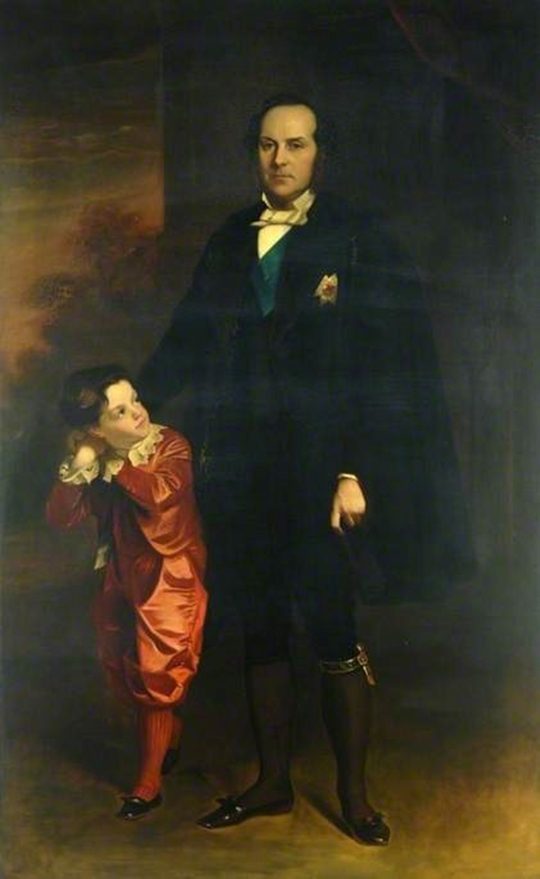
Sir Frank Lockwood
Subject This is the barrister, Sir Frank Lockwood (1846-1897), a member of a prominent Doncaster family. He graduated from Caius College, Cambridge in 1868 and was called to the bar five years later. In 1874, he married Julia Schwabe, the daughter of a German expatriate textile manufacture who had made his fortune in Manchester. Lockwood quickly became a successful counsel in criminal cases and a decade after being called to the bar he was appointed Queen’s Counsel.
However, his most notable case locally was a defeat when, in 1879, he unsuccessfully defended the Sheffield thief and murderer, Charles Peace. A coincidence of interest is that in the same year, William Aldam of Frickley Hall was appointed sheriff of Yorkshire. One of the duties of the sheriff was to be responsible for judges on the assize circuit, and so Aldam was charged with overseeing the arrangements for Peace’s trial and subsequently his execution in Wakefield Prison. The archives of the Warde-Aldam family of Frickley, held at Doncaster Archives, consequently contain a small but interesting quantity of letters and papers relating to the trial and execution.
Lockwood’s career progressed further. In 1884 he was appointed the recorder of Sheffield, that is, the presiding judge in the borough courts. In the previous year, he had stood successfully as a Liberal and was elected as one of the MPs for York. He was a strong supporter of the leading Liberal peer, Lord Roseberry. When Roseberry became Prime Minister in 1894, Lockwood was knighted and became Solicitor-General. The next year, he was barrister for the Crown in another sensational case. This was the prosecution of Oscar Wilde and his associate Alfred Taylor, following the collapse of Wilde’s disastrously misjudged libel action against the Marquess of Queensberry.
It was a carefully-suppressed embarrassment to Lockwood that the man who had introduced Wilde to Taylor, who was a pimp and brothel-keeper, was Maurice Schwabe, who was Lockwood’s nephew by marriage. Schwabe was hurriedly packed off to Australia before the trial began, and the connection between nephew and uncle did not emerge until a long time afterwards. Lockwood was not to be long in office. He lost his official post when Roseberry resigned later in 1895, and he died prematurely, aged only 51, two years later.
Painter Currently unidentified
History of the Portrait The circumstances of the commission and its date are not known. It is not present in the Mansion House inventory of 1900, but was hanging on the walls there by 1901. There is no reference to it any documentary source, including the council minutes, which record other gifts of portraits. Perhaps a hint of an explanation is given in a short-lived periodical called the Doncaster Review. An article there, in January 1895, refers to a suppressed dispute on the council.
The mayor had recently proposed that Lockwood, recently knighted and appointed Solicitor-General, be made an honorary freeman of the borough. Several council members were opposed to the suggestion and so the mayor shelved his proposal. The motive was probably political, since Lockwood was a member of a Liberal government and many members of the council were staunch Conservatives. It may be that Lockwood’s portrait was admitted surreptitiously to prevent opposition.
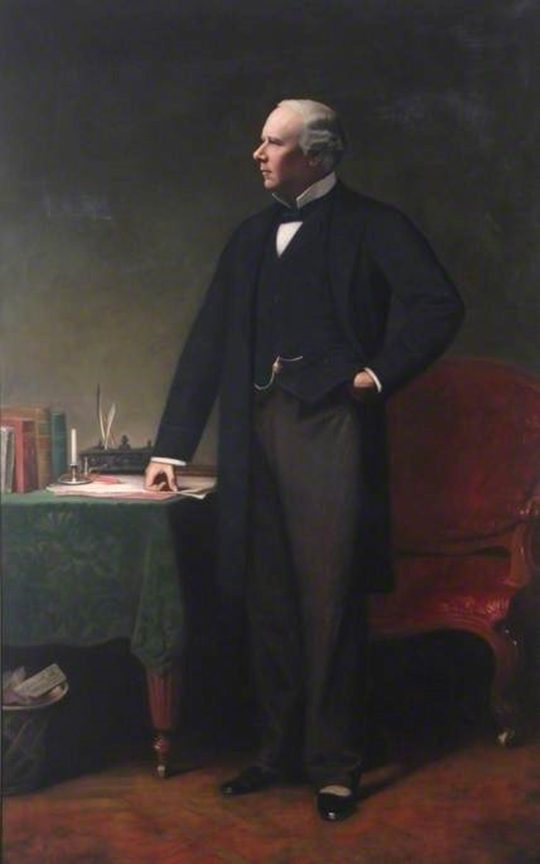
Robert Stockil
Subject Robert Stockil was a member of a local family who contributed much to the prosperity and history of the town. His father, William, had been a currier, or leather-processor, for half a century before his death in 1861. Two of his sons, Charles and Robert, became part of Doncaster’s civic life. Charles succeeded to the leather-working business and became a member of the corporation, and was chosen as mayor in 1867 and again in 1890. A portrait of him is in the possession of Doncaster Art Gallery. Robert his brother (1824-1900), became manager of the Doncaster branch of the Yorkshire Banking Company on the High Street, a Leeds-based bank, not to be confused with the preset-day Yorkshire Bank.
In May 1900, he was made an honorary freeman of the borough but he enjoyed the distinction for only a few months. He died a very wealthy man, worth £66,000 on his death in December 1900, with half his wealth in railway shares and in other companies. In addition to legacies to a multitude of relatives, he also made the town a major benefactor at his death. He bequeathed over £7,000 – then a huge sum of money – to local institutions. The largest beneficiary was the Grammar School, which received £5,000. He gave £1,000 was to St George’s church, £500 to the public library and £900 to three other charities: the Railway Benevolent Institution, the Infirmary, and the School for the Deaf. He also made a bequest of paintings to the corporation.
Painter Currently unidentified
History of the Portrait On the frame of his portrait the donors’ names two donors but they are not known in any other context and were not the executors of Stockil’s will.
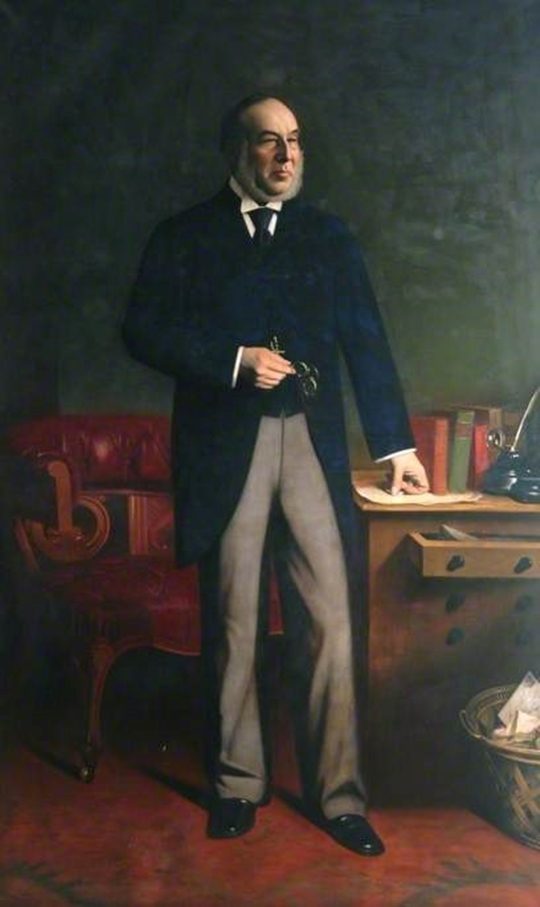
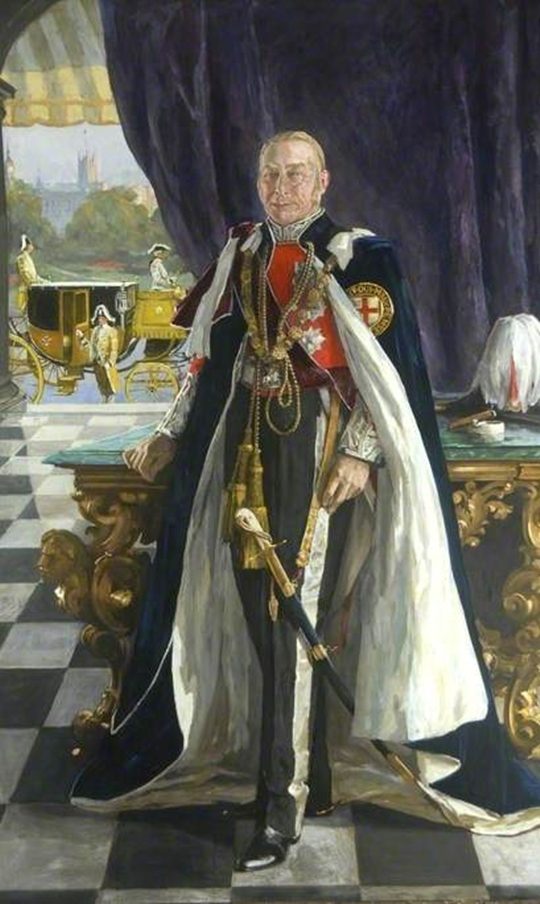
5th Earl Lonsdale
Subject This is Lord Lonsdale, the fifth earl (1857-1944), a bon vivant, spendthrift and sportsman. His extravagant lifestyle was supported, for most but not all of his life, by an income which came from landed estates covering 75,000 acres and from highly-profitable Cumbrian coal mines. He travelled, hunted, and patronised boxing, hence the boxing prize, the Lonsdale Belt, created in 1909. After the 1914-1918 War, his interest turned to the turf and he became steward of the Doncaster course. His horse, Royal Lancer, won the St Leger in 1922, and portraits of owner and horse alike came into the possession of the corporation.
Painter Sir John Lavery (1856-1941) was born in Ireland and trained as an artist in Scotland, where he received patronage from the Glasgow shipbuilder and art collector, William Burrell. He subsequently moved to London an established himself as a leading society portraitist.
History of the Portrait The earl’s portrait, presented to Doncaster by the Earl, was made towards the end of his life. It certainly dates from no earlier than October 1928 when, at the age of 71, he was created a Knight of the Garter. He can be seen proudly wearing the Garter star and costume in the portrait. Outside is a carriage and footmen are all dressed in yellow livery. This was the colour he had adopted for the livery of the Automobile Association, of which he was the first president.